Time to Read: 15 – 20 minutes
By Franky C.
In today’s world, electricity is not a luxury but a necessity. In Florida, this necessity comes at a premium – it’s a squeeze we all feel every month when the bills come in. Our utility situation embodies the worst of what our hyper-capitalist society encourages; Florida is largely serviced by for-profit companies who built their business on providing vital services to our communities, yet are entirely incentivized to prioritize their pockets over our well-being and best interests. However, despite how widespread they are, Duke and FPL are not the only utility providers in Florida. There are other options available to us, more democratically run and not driven by profits, and it’s important to know the differences so we can fight for systems that would improve the lives of our families and neighbors. Utilities are a surprising hot bed of political activity, but too often it sneaks under most Florida residents’ noses. We, of the Sunshine State, are worth more than how these companies have treated us.
Our Utility Providers
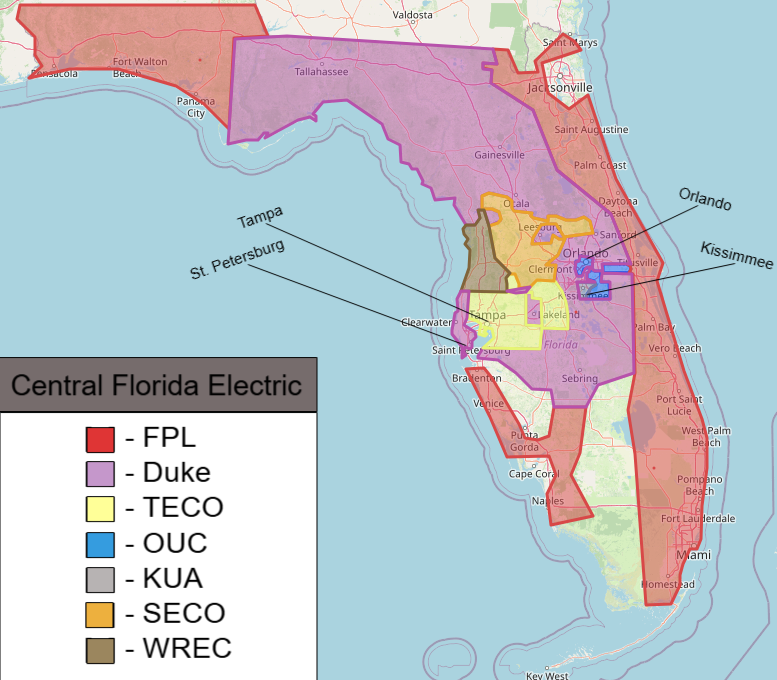
Florida has three types of providers: Investor-Owned Utilities (IOUs), Municipal Utilities, and Rural Cooperatives.1 The differences come from who owns it, who governs it, and their goals outside of providing energy to consumers.
Central Florida’s IOUs include Florida Power & Light Company (FPL), Duke Energy Florida, and Tampa Electric Company (TECO).2 These private companies are owned by shareholders and investors. They primarily govern themselves, but are overseen by the Florida Public Service Commission (FPSC)3, a state-level government commission consisting of five members appointed by the Governor of Florida. Our current PSC members are a mix of Governor Scott and Governor DeSantis’ appointees. While the commission has had oversight on a variety of public dependencies over the years, most relevant is their authority over electric rates.4 IOUs are generally not allowed to set their rates without government approval and instead must go through the PSC before finalizing any changes in rates. However, despite the governmental oversight, these companies are still for-profit, and their relationship with the PSC guarantees them a reasonable rate of return on their profits and infrastructure investments.5
Central Florida’s Municipalities include Orlando Utilities Commission (OUC) and Kissimmee Utility Authority (KUA).6 These are public companies often governed by the cities they reside in via a board of commissions, not unlike the relationship the PSC has with IOUs.7 Unlike the IOUs, who are overseen by a state-wide-focused committee appointed by the Governor, these boards are usually made up of the city mayor and a combination of city and non-city customers. Board members are selected and nominated via a process involving both the current board and the city government. Public utilities like this are non-profit. While Orlando’s OUC allocates much of their revenue into maintaining their infrastructure, they are also frequent sponsors and benefactors of local arts nonprofits, nature preservation, public school support, medical needs for low-income residents, and many more.8 OUC is not unique in giving back to the community, but the extent of their give-back is comparatively significant. IOUs like Duke often have community support programs, however, the stark difference in their self-marketed community pages (linked items 9 and 10) gives astonishingly different impressions. Where OUC cites a plethora of local impact programs they support, Duke’s explanation is scant, and certainly much less community-specific. 9 10
Central Florida’s primary Rural Utility Cooperative is the Seminole Electric Co-Op, which consists of two smaller companies, Sumter Electric Cooperative (SECO) and Withlacoochee River Electric Cooperative (WREC).11 Rural Co-Ops share some similarities with Public Municipalities, but instead of being focused in a singular city, they consist of a coalition of utilities that help service a wider and, as the name implies, more rural area.12 Rural Co-Ops are the closest option we have to a true democratic utility provider; they are member-owned — the employees are customers, and the board members are voted in directly by customers rather than by city/county officials. While the people govern the companies, the membership-companies own the co-op and make decisions with a committee made of the company executives.13 14 While they largely act as a public company, they are in fact private, so while public municipalities are required by the state to provide all records to the public, rural co-ops and IOUs are not required to do this.15 The cooperatives were founded around 1937 to address our rural areas’ struggle to get coverage with existing IOUs and Municipalities who did not wish to expand out into these sparsely populated regions.16 These circumstances have changed vastly as Florida’s growing population demands more power than ever in areas far from the city centers, and these increased energy usages makes them a target for profit-seeking IOUs. Public municipalities also often expand with the demands of the city they reside in. As rural Florida slowly recedes, rural co-ops often lose the power they had.
Central Florida’s Dismal and Heavily Lobbied Utility Situation
Circa March of 2026 17 18 19 20 21 22 23
The utility provider that services your home heavily affects what you pay; some providers charge much more for comparable energy usage, even between neighbors. Below highlights the context of what the customers of these companies pay on average per month as well as the expected prices by the end of 2026.*
- IOUs:
- Public Utilities:
- Rural Coops:
*The above prices are the averages of a typical residential electric bill. Many may see their bill higher or lower than what is seen.
This year’s rate changes provide us with an interesting insight into the ongoing political war happening in the background of Florida. The boards that govern public utilities (appointed either by the city or the customers) approve or deny their respective rate increases which typically need to be justified in a public meeting. IOUs, who are privately governed, need to request a hearing with the PSC, who then either approves or denies their rate changes. FPL’s price rise is attributed to one of these PSC meetings where they requested a rate increase to accommodate the goal of investing more revenue into local infrastructure. This is a valid and typical reason to request increases – SECO’s rate increase was justified the same way.36 However, many have noted that FPL requests an abnormal amount of consecutive price-hikes and that those requests are becoming increasingly larger.37 Jason Garcia, a known corporate accountability reporter, pointed out that this latest PSC-approved rate increase is not only the highest rate increase Florida has ever seen, but now gives them the second highest return in the nation behind Alaska. In fact, Walmart analytics found that FPL, TECO, and Duke ranked in the top ten highest IOU returns in the COUNTRY.38
Duke is actually lowering costs by a substantial amount this year, and while having a lower bill is certainly going to be nice as a Duke customer, the context paints a not-so-nice story. See, utility companies often factor storm costs into their rates. If there is a large storm that causes suitable damage to the area or power grid (such as the three hurricanes we’ve had in the last couple of years), the power companies may raise their costs. These costs will go down for public utilities when the Federal Emergency Management Agency (FEMA) refunds costs required to repair/upgrade infrastructure. For IOUs, the costs will go down if funds are recovered via bonds or deals with the PSC.39 Duke has attributed the recent lowering costs to the removal of storm charges from customer’s bills – which implies Duke was able to recover the costs incurred from the storms.40 This implication is confirmed by Ricardo Cuomo of West Central Florida NPR, who notes that while Duke had reached their goal faster than expected and ended the surcharge to avoid over-collecting, they are still raising the base price.41 When Duke initially proposed a rate hike to recover storm reserves, PSC Staff (Advisors and Analytics) advised the PSC Commission to approve the rate hike to push costs onto customers of the IOUs.42 After the rate hike had been approved, the PSC came under legal trouble from the Florida Supreme Court who accused them of rubber-stamping approvals for these companies.43 In contrast, the rural co-op Central Florida Electric Cooperative (CFEC) raised their prices last year in June, and justified it publicly by providing a breakdown of the damages and costs they incurred from the storms and their insufficient reimbursement by FEMA.44 This comparison highlights the murky relationship IOUs and public utilities have with the government; IOUs receive state-favored price recovery alongside their base price increases while public utilities have to await federal aid from an agency who often finds themselves underfunded to begin with.
The PSC can only approve or deny requests from IOUs without negotiation. With FPLs recent rate hike, they were able to make off-record deals mid-approval with large companies such as Walmart, Publix, or Mosaic who then support them in PSC meetings as lobbyists/PSC members. This forces the government committee into a binary decision: to side with the money or with the people.45 The PSC does not officially receive bribes from Duke, FPL, and TECO – nor are they legally allowed to – and any bribes offered should not influence their decisions to approve or deny proposals; so then, why is the PSC so willing to support IOUs and large corporations when the result of the approval would so obviously harm the residents of Florida? On an entirely unrelated note, within recent years, these IOUs have donated millions to public officials through lobbying and PACs. 46 47 48
Bribes Lobbying and Ghost Candidates
Gainesville has its own public utility company called Gainesville Regional Utilities (GRU), and it has a history of money troubles. These troubles were the perfect excuse for Governor DeSantis to introduce House Bill 1645, which essentially removes control of the company from its board of commissioners to the Governor and five of his own appointees; same public company, but different controllers.49 This controversial bill received pushback from local politicians and activist groups, but their efforts were in vain. First filed on April 10, 2023, the bill passed with nearly a 75% majority in the state’s House of Representatives roughly two-and-a-half weeks later.50 51 Local Democrats warned that this would set a precedent for the state to be allowed to perform a hostile takeover of public utilities with whatever justification the Governor cites. One of the ways local lawmakers and Democrats attempted to fight against this bill was to introduce an amendment that would forbid the sale of GRU without an approving vote from the GRU customers. This amendment was shot down, only further cementing the fear this bill is a step towards an IOU takeover. Democratic Representative Yvonne Hayes Hinson, who happened to be the only member of local legislation who voted against the bill and the only one who actually lives in GRU’s territory, pointed out that this is not the first time the Republican lawmakers who proposed the bill have taken aim at GRU’s management. 52
Journalists of a local newspaper, The Gainesville Iguana, noted this was the fifth time Rep. Keith (R) and Rep. Clemons (R) have tried to remove GRU’s leadership, most aimed at giving GRU an ungoverned and unelected management. In fact, part of the reason House Bill 1645 passed where the previous ones failed was because it circumvented local voters in favor of legislative voters.53 While Clemons has avoided public ties to FPL, Keith was unable to do the same. FPL’s parent company NextEra Energy has faced a major controversy over the years. They are well-known for dumping money to promote “independent” candidates to sway voters away from Democratic candidates. In 2018, Keith won re-election due to one of these alleged “ghost candidates.” NextEra Energy was found to have invested $14.5 million into a nonprofit to run ads to sway voters away from Keith’s opponent. Keith has also directly received about $14,000 of “donations” from various Florida IOUs.54 While FPL hasn’t officially involved itself in this bill, Rep. Hinson did note that FPL had expressed interest in buying the GRU with the former mayor the previous year.55 Both Clemons and Keith denied such claims, and in fact stated on-record that FPL and other IOUs have no interest in buying the GRU customer-base. Although, you can be forgiven for questioning those statements when you consider the events surrounding the attempted sale of Jacksonville Electric Authority (JEA), in which several JEA executives were sentenced to prison for conspiring with FPL to give the private company a clear bid advantage at significant financial gains to themselves.
Around 2018-2020, Jacksonville’s mayor began exploring options to solve the city’s debt problems, and proposed selling JEA, a public utility, to the highest bidder. JEA’s CEO created a plan that would give executives millions when the sale went through, and once JEA opened up biddings for the sale of the company, FPL came out strong as one of the leading bidders.56 According to intense government investigation, FPL seemingly was the intended buyer regardless of other bid offers. The mayor was instrumental in the bidding and sale process to give FPL a clear advantage.57 FPL also notably donated up to $50,000 to charities of the members deciding the bid winner.58
Not only was FPL set up to circumvent the bidding process, but they deployed consultants to ensure their success, and many of the bidding officials had close ties to them.58 Their final bid amounted to $11 billion to the total sale of JEA.60 Fortunately, the public caught wind of a city auditor’s report, and kicked up a massive outcry. Because of this, the conspirators were officially investigated, found guilty and jailed.61 The reporter who revealed the charity dealings, Nate Monroe, is a well-known local journalist and frequent FPL-criticizer who wrote a piece against FPL’s efforts to purchase the Jacksonville public utility. FPL gave credibility to Monroe’s claims when, in response to his article, they had him stalked by private investigators(!); FPL executives were supplied with information on Monroe such as photographs of him, his location, and his active movements.62 So while FPL denies influencing the events behind the GRU takeover, it is clear that this wouldn’t be the first time FPL has attempted to buy out a public utility and attempted to do so with ruthless dirty tactics.
Throwing money at decision-making politicians is a tactic that many for-profit utility companies take healthy advantage of. Back in 2021, a set of bills were introduced in Florida aimed to cut city/county power to choose what energy sources they allow in their areas, and instead move that power up to the state. Companies such as FPL and TECO (which primarily covers Tampa) were found to have donated and lobbied money in support of these bills. TECO specifically publicly gave about $135,000 towards politicians backing the bills.63 While there has been a concerted effort to move into clean energy such as solar, a lot of utilities primarily obtain energy from non-renewable methods such as gas or coal. When there is a legislative push towards renewable energy, pushback arises from gas and oil companies. Before these bills were introduced, Tampa was aiming to become 100% clean energy reliant, but of course, since part of TECO’s revenue comes from gas utilities, it was in their shareholder’s best interest to take away Tampa’s ability to decide for themselves what type of power sources they have access to. Instead, the bill passed the decision-making to legislators who were already taking their financial backing. Who else would get in the way of progress and efforts to save Mother Earth then IOUs who may lose some profit?
The Cold-War of Orlando
Our neighbors in St. Petersburg are facing a decision on which type of utility provider they want. Richie Floyd, St. Pete’s District 8 City Council Vice-Chair and proud democratic socialist, ran in part on this very decision. Duke provides energy to St. Petersburg under a thirty-year contract and as this contract is coming to a close, the residents of the city are showing their attitude towards being Duke clients; they want out, and it isn’t hard to see why. Floyd stated to our local Orlando Democratic Socialists of America group (ODSA) that he proposed creating a St. Pete municipal utility modeled after OUC, and received bipartisan support. It is the people’s wish to create their own utility and so it is the people who need to turn out in support of the efforts to do this, and to be aware of what each side would represent for them.
Like anywhere in Florida, your power provider is determined by where you live and here in Orlando, close to home for ODSA, many of us have the “choice” of Duke or OUC. On the surface, Orlando might seem lucky – both of our power providers are decreasing rates this year, rates that are comparable to each other. But we’ve discussed how IOUs are incentivized to prioritize shareholder pockets over the well-being and autonomy of their customers. Duke Energy Florida has seen its fair share of scandals such as promoting ghost candidates, as reported by Orlando Sentinel.64 Duke Energy also frequently raises fixed prices, attacks energy efficiency programs, and makes it harder for customers to move to solar.65 All of these efforts hurt low-income customers, a hurt that’s exacerbated when they further underfund in-house and out-house programs meant to help these customers pay their bills.66 All the while, they kill Florida bills that would limit the amount of money they are able to squeeze out of us.67 Environmental Working Group (EWG) performed an extensive study on Duke Energy and found that even with Duke underfunding its own programs, much of that money comes from ratepayers in the form of mandatory bill charges – not from the company itself. Back when Duke was given the rubber-stamp approval for storm surcharges, were raising base price hikes, and were under-funding aid programs for customers, watchdog reports found a nefarious detail. The reports pointed out that during these price hikes and storm costs (which are pushed onto the customers), and after they filed to recover $1.1 billion in hurricane damages, Duke maintained their profit margins and executives still received their bonuses.68 Can a company truly be helping the people and the state when they’re profiting off of our disasters? When it comes to resident wellbeing, Duke is no better than FPL.
On the other hand, OUC has recently started rolling out a project called PeakShift. This program decreases all customer base rates and implements a pay-what-you-use model. Later phases of the project will expand access to community solar farms for non-solar owners and charge customers a variable rate based on high energy usage times of day to decrease the strain on OUC’s power infrastructure. As stated before, OUC is non-profit – PeakShift may increase or decrease people’s bills, but the intent of the project is to be revenue neutral, not to earn OUC more money.69 While the pilot of the program had a 98% approval rate, it has not stopped speculation and criticism of this project announcement. Some of the criticism OUC faced for this program included accusations of financial strain, outcry from decreasing homeowner solar incentives, and claims that this program is pushing the costs of data center overconsumption onto customers.70 71 Critiques related to the data centers can often be found on local online forums, but if PeakShift works as intended, those data centers would be charged more for their extra usage. It seems that lack of clear information about the program is breeding customer distrust. Opposition surrounding solar changes often come from solar advocacy groups or groups such as FaSEIA, which represent private solar developers and companies.72 While solar critics of the program are valid, OUC has more than a few solar programs. With protests organized by solar advocacy groups like FaSEIA being tied so closely to private companies worried about losing profit, I’m reluctant to advocate this cause. The concerns about OUC’s potential financial strains – stated by City Commissioner Patty Sheehan – comes closest to the truth of the matter. Every utility company, IOUs included, have either stated or implied that Florida’s power grid and infrastructure is struggling under the influx of people moving to our Sunshine State. A census revealed that nearly one million people moved to Florida in 2024.73 Eventually, utility companies like OUC may need to rely on more than just the existing power plants like Stanton Energy Center or their green energy initiatives to supply energy to residents.
The PSC has limited oversight on public municipalities, but they aren’t the only power public utilities are beholden to in Florida. The Governor, his cabinet, or the Secretary of the Florida Department of Environmental Protection was granted power back in 1973 via the Florida Power Plant Siting Act (PPSA) to approve or veto new power plants in our state.74 While the FDEP secretary isn’t exactly known as a power house protecting our environments against over-development – they would only be able to grant approval in the case of a non-contested proposal. Otherwise, the plan would need to be approved by Governor DeSantis or his cabinet. You may begin to see the dicey situation this can put OUC in if they are beholden to the very same Governor who played a large part in the GRU debacle a few years ago. If both Duke and OUC cite requests for new plants, who is the state more likely to favor? If you’re still unsure, Scott Maxwell of the Orlando Sentinel published an article earlier this year (March 2026) discussing how IOUs killed a bill to give company profits more transparency, and that these companies donated half a million to one of DeSantis’ leading successors.75
In today’s world, electricity is not a luxury but a necessity. In Florida, this necessity comes at a premium – it’s a squeeze we all feel every month when the bills come in. However, this squeeze can be fought by us, the people under public utilities. Our vote matters when our utilities are controlled either by us or by the city officials we vote in. For too long has the politics of utilities been considered a “sleepy” gold-mine for corruption and greed to mine at under our feets. If a public utility tries to bleed us dry, our vote and voice has influence to change that; if an IOU bleeds us dry, we are shit out of luck. It isn’t a Socialist movement to rise against IOUs, it isn’t a Democratic, or a Republican one; It is a FLORIDA movement, it is our responsibility to show up when it matters to show that our voices matter more than their money.
Footnotes
- Florida Department of Agriculture and Consumer Services (FDACS), “Electric Utilities, last updated April 3, 2026, 9:25 (UTC), https://www.fdacs.gov/Business-Services/Energy/Florida-Energy-Clearinghouse/Electric-Utilities. ↩︎
- FDACS, “Electric Utilities.” ↩︎
- FDACS, “Electric Utilities.” ↩︎
- Florida Public Service Commission (FPSC), “About the PSC,” last updated April 1, 2026, 14:30 (UTC), https://www.floridapsc.com/about. ↩︎
- Wikipedia, “Florida Public Service Commission,” last updated March 30, 2026, 9:45 (UTC), https://en.wikipedia.org/wiki/Florida_Public_Service_Commission. ↩︎
- FDACS, “Electric Utilities.” ↩︎
- FDACS, “Electric Utilities.” ↩︎
- Orlando Utilities Commission (OUC), “Our Community Focus Areas,” last updated April 3, 2026, 22:20 (UTC), https://www.ouc.com/community/focus-areas/. ↩︎
- OUC, “Our Community Focus Areas.” ↩︎
- Duke Energy, “Giving Back,” last updated April 4, 2026, 12:30 (UTC), https://www.duke-energy.com/our-company/about-us/giving-back. ↩︎
- FDACS, “Electric Utilities.” ↩︎
- FDACS, “Electric Utilities.” ↩︎
- Withlacoochee River Electric Cooperative (WREC), “About WREC,” last updated April 4, 2026, 13:18 (UTC), https://wrec.net/about-wrec. ↩︎
- Duke Energy, “Giving Back.” ↩︎
- Fla. Stat. §§ 425.04, .09 (2025). ↩︎
- Florida Electric Cooperatives Association, Inc. (FECA), “Our History,” last updated April 3, 2026, 7:30 (UTC), https://feca.com/about/our-history/. ↩︎
- WREC, “About WREC.” ↩︎
- Map of reported power outages in the Orlando area, OUC, last updated April 4, 2026, 14:47 (UTC), https://outagemap.ouc.com/. ↩︎
- Kissimmee Utility Authority (KUA), “About Us: Service Territory,” last updated April 4, 2026, 14:13 (UTC), https://kua.com/about-kua/service-territory/. ↩︎
- Tampa Electric Company (TECO), “Service Area & Reliability,” last updated April 4, 2026, 14:22 (UTC), https://www.tampaelectric.com/economicdevelopment/serviceareaandreliability/. ↩︎
- Map of reported power outages in the state of Florida, Duke Energy, last updated March 18, 2026, 20:05 (UTC), https://outagemap.duke-energy.com/#/current-outages/fl. ↩︎
- Map of reported power outages in the state of Florida, Florida Power & Light (FPL), last updated April 5, 2026, 7:47 (UTC), https://www.fplmaps.com/. ↩︎
- Map of service area and table of government contacts in the state of Florida (PDF), FPL External Affairs, April 24, 2025, https://www.fpl.com/government/pdf/gov-contacts.pdf. ↩︎
- Find Energy, “Florida Power & Light: Electricity Rates, Plans & Statistics,” last updated April 7, 2026, 14:13 (UTC), https://findenergy.com/providers/florida-power-light/. ↩︎
- Florida Power & Light (FPL) Newsroom, “FPL rate settlement reduces request by nearly a third, limits average annual bill increases to 2%, maintains consumer protections,” August 20, 2025, https://newsroom.fpl.com/2025-08-20-FPL-rate-settlement-reduces-request-by-nearly-a-third,-limits-average-annual-bill-increases-to-2-,-maintains-consumer-protections. ↩︎
- Find Energy, “Duke Energy Florida.” ↩︎
- Duke Energy News Center, “Duke Energy Florida announces significantly lower bills in 2026; residential customers using 1,000 kWh to see approximately $44 decrease beginning in March,” September 4, 2025, https://news.duke-energy.com/releases/duke-energy-florida-announces-significantly-lower-bills-in-2026-residential-customers-using-1-000-kwh-to-see-approximately-44-decrease-beginning-in-march. ↩︎
- Phillip Stucky, “Duke Energy gets approval to increase base rates through 2027,” Spectrum News 13, August 21, 2024, https://mynews13.com/fl/orlando/news/2024/08/21/duke-energy-rate-increase-request-approval. ↩︎
- Find Energy, “Tampa Electric.” ↩︎
- Aaron Mesmer, “Fourth TECO rate hike in 12 months finalized, set to take effect in January,” Fox News 13, November 6, 2025, https://www.fox13news.com/news/teco-customers-looking-rate-hike-new-year. ↩︎
- Find Energy, “Kissimmee Utility Authority.” ↩︎
- Find Energy, “Orlando Utilities Commission.” ↩︎
- OUC PeakShift, “OUC PeakShift Programs: Your Power, Your Choice,” last updated March 24, 2026, 16:21 (UTC), https://www.oucpeakshift.com/. ↩︎
- Find Energy, “SECO Energy.” ↩︎
- Find Energy, “WREC Energy.” ↩︎
- Sumter Electric Cooperative, Inc. (SECO) Energy, “Rate Adjustment,” last updated April 4, 2026, 18:08 (UTC), https://secoenergy.com/rate-adjustment/. ↩︎
- FPL Newsroom, “FPL rate settlement reduces requests by nearly a third.” ↩︎
- Jason Garcia, “Florida just approved the largest electric rate increase in history. Here’s how it happened,” Seeking Rents, Substack, November 23, 2025, https://jasongarcia.substack.com/p/florida-just-approved-the-largest. ↩︎
- Duke Energy News Center, “Duke Energy Florida announces significantly lower bills in 2026.” ↩︎
- Duke Energy News Center, “Duke Energy Florida announces significantly lower bills in 2026.” ↩︎
- Ricardo Cuomo, “Lower bills are coming as Duke Energy ends storm recovery charge early,” WUSF-NPR, January 26, 2026, https://www.wusf.org/economy-business/2026-01-26/duke-energy-florida-ends-storm-recovery-charge-early. ↩︎
- Jim Saunders, “Florida PSC staff recommends that customers pay Duke and TECO $1.55 billion for hurricane costs,” News Service of Florida for WMNF, January 27, 2025, https://www.wmnf.org/florida-psc-staff-recommends-customers-pay-duke-teco-1-55-billion-hurricane-costs/. ↩︎
- Duke Accountability Florida, “Why are we paying storm bills while executives get millions in bonuses?” last updated April 7, 2026,14:57 (UTC), https://dukeaccountabilityfl.com/. ↩︎
- Central Florida Electric Cooperative, Inc. (CFEC), “July 2025 Rate Adjustment,” last updated April 7, 2026, 15:00 (UTC), https://www.cfec.com/july-2025-rate-adjustment/. ↩︎
- Garcia, “Florida just approved the largest electric rate increase in history.” ↩︎
- Wikipedia, “NextEra Energy.” ↩︎
- Wikipedia, “Duke Energy: Criticism.” ↩︎
- Duke Accountability Florida, “Why are we paying storm bills?” ↩︎
- Fla. HB 1645, § 7.04, at 6, lines 131-132 (2023), https://www.flsenate.gov/Session/Bill/2023/1645/BillText/er/PDF. ↩︎
- The Florida Senate. “Bill History.” CS/HB 1645: City of Gainesville, Alachua County. Last updated April 10, 2026 at 16:13 (UTC). https://www.flsenate.gov/Session/Bill/2023/1645/?Tab=BillHistory. ↩︎
- Elliot Tritto, “Gainesville votes to dissolve GRU Authority, return control of utility back to city,” The Gainesville Sun, November 4, 2025, https://www.gainesville.com/story/news/politics/elections/2025/11/04/gainesville-florida-approves-2025-referendum-to-dissolve-gru-authority/87064800007/. ↩︎
- Andrew Caplan, “Florida House passes GRU takeover bill with majority vote. What happens now?” The Gainesville Sun, April 27, 2023, https://www.gainesville.com/story/news/local/2023/04/27/florida-house-passes-gru-takeover-bill-with-majority-vote/70158863007/. ↩︎
- Susan Bottcher, “Abolish DeSantis GRU Authority, vote YES on Local Public Utilities to keep Gainesville local,” The Gainesville Iguana 38, no. 8 (August 2024): 12-13, https://gainesvilleiguana.org/wp-content/uploads/2024/07/August-2024-Iguana-for-web.pdf. ↩︎
- Wikipedia, “NextEra Energy.” ↩︎
- Jennifer Cabrera, “Clemons’ GRU bill passes in the House, 81-33,” Alachua Chronicle, April 27, 2023, https://alachuachronicle.com/clemons-gru-bill-passes7-in-the-house-81-33/. ↩︎
- Jacksonville City Council, “Chronology of Material Events,” Report of the Special Investigatory Committee on JEA Matters, December 2020, p. 53, 119, 142, & 128. https://jeainvestigation.com/wp-content/uploads/2020/12/2.-Chronology-Online.pdf. ↩︎
- Daniel Tait, “Investigation revealed NextEra’s inside track for JEA, coordination with Curry Administration,” Energy & Policy Institute, February 3, 2021, https://energyandpolicy.org/investigation-revealed-nexteras-inside-track-for-jea/. ↩︎
- Nate Monroe, “Dear FP&L, it’s not really charity if you get something out of it,” Florida Times-Union, October 1, 2020, https://www.jacksonville.com/story/news/columns/nate-monroe/2020/10/01/nate-monroe-fp-ls-strategic-jea-gifts/5868864002/. ↩︎
- Nate Monroe, “Dear FP&L, it’s not really charity if you get something out of it,” Florida Times-Union, October 1, 2020, https://www.jacksonville.com/story/news/columns/nate-monroe/2020/10/01/nate-monroe-fp-ls-strategic-jea-gifts/5868864002/. ↩︎
- Monroe, “Dear FP&L.” ↩︎
- Tait, “Investigation revealed NextEra’s inside track for JEA.” ↩︎
- Mario Alejandro Ariza and Annie Martin, “A Florida power company didn’t like a journalist’s commentary. Its consultants had him followed,” The Guardian (Floodlight Florida), June 24, 2022, https://www.theguardian.com/environment/2022/jun/24/a-florida-power-company-didnt-like-a-journalists-commentary-its-consultants-had-him-followed. ↩︎
- Emily Pontecorvo and Brendan Rivers, “A Florida city wanted to move away from fossil fuels. The state made sure it couldn’t,” Jacksonville Today, July 29, 2021, https://jaxtoday.org/2021/07/29/a-florida-city-wanted-to-move-away-from-fossil-fuels-the-state-made-sure-it-couldnt/. ↩︎
- Wikipedia, “Duke Energy: Criticism.” ↩︎
- Alex Formuzis, “Report: Duke Energy Policies Consistently Harm Low-Income Customers,” Environmental Working Group (EWG), June 3, 2020, https://www.ewg.org/news-insights/news-release/2020/06/report-duke-energy-policies-consistently-harm-low-income. ↩︎
- Formuzis, “Report.” ↩︎
- Emily L. Mahoney, “Florida bill to slash utility profits dies after Duke Energy, FPL lobbying,” Tampa Bay Times, May 5, 2025, https://www.tampabay.com/news/business/2025/05/05/duke-energy-florida-power-light-lobbying-bill-utility-profit-don-gaetz/. ↩︎
- Duke Accountability Florida, “Why are we paying storm bills?” ↩︎
- OUC PeakShift, “Programs.” ↩︎
- Molly Duerig, “Solar industry advocates blast Orlando utility proposal ahead of Tuesday vote,” Central Florida Public Media, December 5, 2025, https://www.cfpublic.org/environment/2024-12-05/concerns-ouc-peakshift-rally. ↩︎
- Greg Fox, “Orlando Utilities Commission approves controversial PeakShift plan,” WESH 2 News, December 10, 2024, https://www.wesh.com/article/orlando-utilities-commission-ouc-approves-controversial-peakshift-plan/63151622. ↩︎
- Florida Solar Energy Industries Association (FLaSEIA), “About Us,” last updated April 11, 2026, 15:57 (UTC), https://www.flaseia.org/about-us/. ↩︎
- Anthony Talcott, “Nearly 900K people moved to Florida, new data shows. Here’s where they came from,” WKMG-TV News 6, January 22, 2026, https://www.clickorlando.com/news/local/2026/01/22/nearly-900k-people-moved-to-florida-new-data-shows-heres-where-they-came-from/. ↩︎
- Florida Department of Environmental Protection (FDEP), “Power Plant Siting Act (PPSA),” last updated April 12, 2026, 15:15 (UTC), https://floridadep.gov/water/siting-coordination-office/content/power-plant-siting-act. ↩︎
- Scott Maxwell, “FPL blocks plan to cut power bills in Florida, sees big profits,” Orlando Sentinel, March 25, 2026, https://www.orlandosentinel.com/2026/03/25/fpl-profits-desantis-trump/. ↩︎
Bibliography
Alejandro Ariza, Mario, and Annie Martin. “A Florida power company didn’t like a journalist’s commentary. Its consultants had him followed.” The Guardian (Floodlight Florida), June 24, 2022. https://www.theguardian.com/environment/2022/jun/24/a-florida-power-company-didnt-like-a-journalists-commentary-its-consultants-had-him-followed.
Bottcher, Susan. “Abolish DeSantis GRU Authority, vote YES on Local Public Utilities to keep Gainesville local.” The Gainesville Iguana 38, no. 8 (August 2024): 12-13. https://gainesvilleiguana.org/wp-content/uploads/2024/07/August-2024-Iguana-for-web.pdf.
Cabrera, Jennifer. “Clemons’ GRU bill passes in the House, 81-33.” Alachua Chronicle, April 27, 2023. https://alachuachronicle.com/clemons-gru-bill-passes-in-the-house-81-33/.
Caplan, Andrew. “Florida House passes GRU takeover bill with majority vote. What happens now?” The Gainesville Sun, April 27, 2023. https://www.gainesville.com/story/news/local/2023/04/27/florida-house-passes-gru-takeover-bill-with-majority-vote/70158863007/.
Central Florida Electric Cooperative, Inc. “July 2025 Rate Adjustment.” Last updated April 7, 2026 at 15:00 (UTC). https://www.cfec.com/july-2025-rate-adjustment/.
Cuomo, Ricardo. “Lower bills are coming as Duke Energy ends storm recovery charge early.” WUSF-NPR, January 26, 2026. https://www.wusf.org/economy-business/2026-01-26/duke-energy-florida-ends-storm-recovery-charge-early.
Duerig, Molly. “Solar industry advocates blast Orlando utility proposal ahead of Tuesday vote.” Central Florida Public Media, December 5, 2025. https://www.cfpublic.org/environment/2024-12-05/concerns-ouc-peakshift-rally.
Duke Accountability Florida. “Why are we paying storm bills while executives get millions in bonuses?” Last updated April 7, 2026 at 14:57 (UTC). https://dukeaccountabilityfl.com/.
Duke Energy. “Giving Back.” Last updated April 4, 2026 at 12:30 (UTC). https://www.duke-energy.com/our-company/about-us/giving-back.
Duke Energy News Center. “Duke Energy Florida announces significantly lower bills in 2026; residential customers using 1,000 kWh to see approximately $44 decrease beginning in March.” September 4, 2025. https://news.duke-energy.com/releases/duke-energy-florida-announces-significantly-lower-bills-in-2026-residential-customers-using-1-000-kwh-to-see-approximately-44-decrease-beginning-in-march.
Find Energy. “Duke Energy Florida: Electricity Rates, Plans & Statistics.” Last updated April 7, 2026 at 14:01 (UTC). https://findenergy.com/providers/duke-energy-florida/.
Find Energy. “Florida Power & Light: Electricity Rates, Plans & Statistics.” Last updated April 7, 2026 at 14:13 (UTC). https://findenergy.com/providers/florida-power-light/.
Find Energy. “Kissimmee Utility Authority: Electricity Rates, Plans & Statistics.” Last updated April 7, 2026 at 14:33 (UTC). https://findenergy.com/providers/kissimmee-utility-authority/.
Find Energy. “Orlando Utilities Commission: Electricity Rates, Plans & Statistics.” Last updated April 7, 2026 at 14:37 (UTC). https://findenergy.com/providers/orlando-utilities-commission/.
Find Energy. “SECO Energy: Electricity Rates, Plans & Statistics.” Last updated April 7, 2026 at 14:49 (UTC). https://findenergy.com/providers/seco-energy/.
Find Energy. “Tampa Electric: Electricity Rates, Plans & Statistics.” Last updated April 7, 2026 at 14:28 (UTC). https://findenergy.com/providers/tampa-electric/.
Find Energy. “WREC Energy: Electricity Rates, Plans & Statistics.” Last updated April 7, 2026 at 14:55 (UTC). https://findenergy.com/providers/withlacoochee-river-electric-cooperative/.
Florida Department of Agriculture and Consumer Services. “Electric Utilities.” Last updated April 3, 2026 at 9:25 (UTC). https://www.fdacs.gov/Business-Services/Energy/Florida-Energy-Clearinghouse/Electric-Utilities.
Florida Department of Environmental Protection. “Power Plant Siting Act.” Last updated April 12, 2026 at 15:15 (UTC). https://floridadep.gov/water/siting-coordination-office/content/power-plant-siting-act.
Florida Electric Cooperatives Association, Inc. “Our History.” Last updated April 3, 2026 at 7:30 (UTC). https://feca.com/about/our-history/.
Florida Power & Light Newsroom. “FPL rate settlement reduces request by nearly a third, limits average annual bill increases to 2%, maintains consumer protections.” August 20, 2025. https://newsroom.fpl.com/2025-08-20-FPL-rate-settlement-reduces-request-by-nearly-a-third,-limits-average-annual-bill-increases-to-2-,-maintains-consumer-protections.
Florida Public Service Commission. “About the PSC.” Last updated April 1, 2026 at 14:30 (UTC). https://www.floridapsc.com/about.
Florida Solar Energy Industries Association. “About Us.” Last updated April 11, 2026 at 15:57 (UTC). https://www.flaseia.org/about-us/.
Formuzis, Alex. “Report: Duke Energy Policies Consistently Harm Low-Income Customers.” Environmental Working Group, June 3, 2020. https://www.ewg.org/news-insights/news-release/2020/06/report-duke-energy-policies-consistently-harm-low-income.
Fox, Greg. “Orlando Utilities Commission approves controversial PeakShift plan.” WESH 2 News, December 10, 2024. https://www.wesh.com/article/orlando-utilities-commission-ouc-approves-controversial-peakshift-plan/63151622.
Garcia, Jason. “Florida just approved the largest electric rate increase in history. Here’s how it happened.” Seeking Rents. Substack. November 23, 2025. https://jasongarcia.substack.com/p/florida-just-approved-the-largest.
Jacksonville City Council. “Chronology of Material Events.” Report of the Special Investigatory Committee on JEA Matters, December 2020. https://jeainvestigation.com/wp-content/uploads/2020/12/2.-Chronology-Online.pdf.
Kissimmee Utility Authority. Interactive Outage Map. Last accessed “About Us: Service Territory.” Last updated April 4, 2026 at 14:13 (UTC). https://kua.com/about-kua/service-territory/.
Mahoney, Emily L. “Florida bill to slash utility profits dies after Duke Energy, FPL lobbying.” Tampa Bay Times, May 5, 2025, https://www.tampabay.com/news/business/2025/05/05/duke-energy-florida-power-light-lobbying-bill-utility-profit-don-gaetz/.
Maxwell, Scott. “FPL blocks plan to cut power bills in Florida, sees big profits.” Orlando Sentinel, March 25, 2026. https://www.orlandosentinel.com/2026/03/25/fpl-profits-desantis-trump/.
Mesmer, Aaron. “Fourth TECO rate hike in 12 months finalized, set to take effect in January.” Fox News 13, November 6, 2025. https://www.fox13news.com/news/teco-customers-looking-rate-hike-new-year.
Monroe, Nate. “Dear FP&L, it’s not really charity if you get something out of it.” Florida Times-Union, October 1, 2020. https://www.jacksonville.com/story/news/columns/nate-monroe/2020/10/01/nate-monroe-fp-ls-strategic-jea-gifts/5868864002/.
Orlando Utilities Commission. “Our Community Focus Areas.” Last updated April 3, 2026 at 22:20 (UTC). https://www.ouc.com/community/focus-areas/.
Orlando Utilities Commission PeakShift. “OUC PeakShift Programs: Your Power, Your Choice.” Last updated March 24, 2026 at 16:21 (UTC). https://www.oucpeakshift.com/.
Pontecorvo, Emily, and Brendan Rivers. “A Florida city wanted to move away from fossil fuels. The state made sure it couldn’t.” Jacksonville Today, July 29, 2021. https://jaxtoday.org/2021/07/29/a-florida-city-wanted-to-move-away-from-fossil-fuels-the-state-made-sure-it-couldnt/.
Saunders, Jim. “Florida PSC staff recommends that customers pay Duke and TECO $1.55 billion for hurricane costs.” News Service of Florida for WMNF, January 27, 2025. https://www.wmnf.org/florida-psc-staff-recommends-customers-pay-duke-teco-1-55-billion-hurricane-costs/.
Stucky, Phillip. “Duke Energy gets approval to increase base rates through 2027.” Spectrum News 13, August 21, 2024. https://mynews13.com/fl/orlando/news/2024/08/21/duke-energy-rate-increase-request-approval.
Sumter Electric Cooperative, Inc. Energy. “Rate Adjustment.” Last updated April 4, 2026 at 18:08 (UTC). https://secoenergy.com/rate-adjustment/.
Tait, Daniel. “Investigation revealed NextEra’s inside track for JEA, coordination with Curry Administration.” Energy & Policy Institute. February 3, 2021. https://energyandpolicy.org/investigation-revealed-nexteras-inside-track-for-jea/.
Talcott, Anthony. “Nearly 900K people moved to Florida, new data shows. Here’s where they came from.” WKMG-TV News 6, January 22, 2026. https://www.clickorlando.com/news/local/2026/01/22/nearly-900k-people-moved-to-florida-new-data-shows-heres-where-they-came-from/.
Tampa Electric Company. “Service Area & Reliability.” Last updated April 4, 2026 at 14:22 (UTC). https://www.tampaelectric.com/economicdevelopment/serviceareaandreliability/.
The Florida Senate. “Bill History.” CS/HB 1645: City of Gainesville, Alachua County. Last updated April 10, 2026 at 16:13 (UTC). https://www.flsenate.gov/Session/Bill/2023/1645/?Tab=BillHistory.
Tritto, Elliot. “Gainesville votes to dissolve GRU Authority, return control of utility back to city.” The Gainesville Sun, November 4, 2025. https://www.gainesville.com/story/news/politics/elections/2025/11/04/gainesville-florida-approves-2025-referendum-to-dissolve-gru-authority/87064800007/.
Wikipedia, “Duke Energy: Criticism.” Last updated April 4, 2026 at 9:14 (UTC). https://en.wikipedia.org/wiki/Duke_Energy#Criticism.
Wikipedia, “Florida Public Service Commission.” Last updated March 30, 2026 at 9:45 (UTC). https://en.wikipedia.org/wiki/Florida_Public_Service_Commission.
Wikipedia, “NextEra Energy.” Last updated April 1, 2026 at 7:30 (UTC). https://en.wikipedia.org/wiki/NextEra_Energy.
Withlacoochee River Electric Cooperative. “About WREC.” Last updated April 4, 2026 at 13:18 (UTC). https://wrec.net/about-wrec.